


When to Thaw a Turkey for Thanksgiving 2026 by Weight
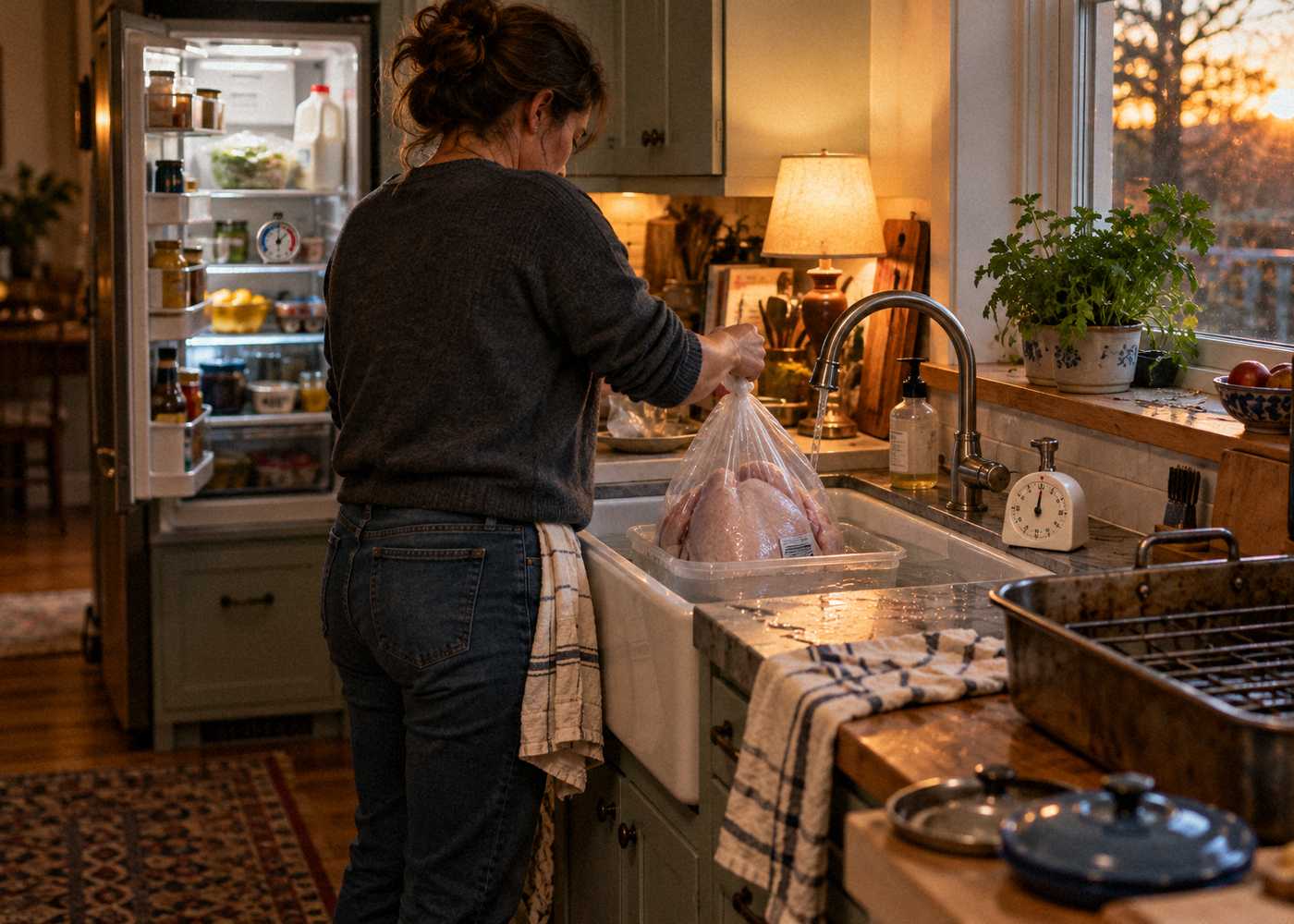
When should a frozen turkey go into the refrigerator so it is ready for Thanksgiving dinner on Thursday, November 26, 2026? For most birds, between Friday, November 20 and Wednesday, November 25, depending on weight. A 12-pound turkey starts on Monday, November 23, and a 24-pound turkey starts on Friday, November 20, both at 9 a.m.
Those dates are planning estimates I calculated from published thawing rates, not deadlines from any health agency or turkey brand, and no chart can guarantee that a particular bird will be thawed on time. This guide helps you pick a start date, check progress and fix a turkey that is still frozen.
What do you need before you start?
Gather these first:
- The labeled weight of your turkey and the time you want it in the oven
- Refrigerator space, ideally on a bottom shelf
- A tray or pan to catch drips
- A refrigerator thermometer and a food thermometer
For the cold-water backup, also have a leakproof bag, a large clean container (a clean sink works too) and a 30-minute timer.
Step 1: What does the label say, and how cold is your refrigerator?
Read the weight on the label and round up if you are between numbers. Then check the refrigerator thermometer. FoodSafety.gov says the refrigerator should be at 40°F (about 4°C) or below for thawing, and a dial setting does not tell you that.
Until thawing begins, keep the turkey in a freezer at 0°F or below. The CDC warns against places where no one monitors the temperature, such as porches, car trunks and snow.
Also read the package. A commercially frozen pre-stuffed turkey with a USDA or state inspection seal should be cooked from frozen, not thawed, according to University of Florida guidance. Do not apply the schedule below to it.
Step 2: When should you start thawing, based on weight?
The rule of thumb is about 24 hours in the refrigerator for every 4 to 5 pounds. The federal chart gives ranges, and those ranges overlap at boundary weights, so a 12-pound or 16-pound bird could fit two bands. To avoid conflicting dates, the table below uses one day per 4 pounds, rounded up to whole days, which is the more cautious end. It assumes the turkey goes into the oven at 9 a.m. on Thanksgiving.
| Labeled weight | Full days | Start in the refrigerator |
|---|---|---|
| 4 pounds | 1 | Wednesday, November 25, 9 a.m. |
| 8 pounds | 2 | Tuesday, November 24, 9 a.m. |
| 10 or 12 pounds | 3 | Monday, November 23, 9 a.m. |
| 14 or 16 pounds | 4 | Sunday, November 22, 9 a.m. |
| 18 or 20 pounds | 5 | Saturday, November 21, 9 a.m. |
| 22 or 24 pounds | 6 | Friday, November 20, 9 a.m. |
If your oven start is noon, the matching thaw start is noon on the same day. Count in full 24-hour periods, not calendar days.
That matters for a common question: does starting Sunday night give you four days before Thursday morning? No. Sunday at 6 p.m. to Thursday at 9 a.m. is three days and 15 hours, which is less than four days. A 16-pound turkey needs Sunday morning at 9 a.m., or you should plan on the cold-water finish described below.
Step 3: How do you refrigerate the wrapped turkey?
Leave the turkey in its original wrapper and set it on the tray in the bottom section of the refrigerator, as Illinois Extension recommends. The bottom shelf and tray keep raw juices from dripping onto other food.
Do not thaw it on the counter, and do not use warm or hot water. Counter thawing lets bacteria multiply on the surface, and a frozen center does not mean the outside is cold enough to be safe.
Do not rinse the raw turkey. Splashes spread bacteria around your kitchen. Wash your hands for at least 20 seconds after handling it.
How long can a thawed turkey wait, and does brining count?
Here is where an early start can backfire. A turkey thawed in the refrigerator can stay there for 1 to 2 days before cooking, according to the CDC. That clock starts when the bird is fully thawed, not when it goes into the refrigerator.
A bird that thaws faster than the chart predicts has used up more of its storage time, so judge by the actual state of the turkey, not the calendar.
Brining does not add time. USDA-authored guidance says to keep the turkey and the brine at 40°F or below and brine for no longer than two days. If you plan an overnight brine after the thaw, that night counts inside the 1 to 2 days. A turkey that finishes thawing on Tuesday and brines overnight on Wednesday is already near the limit by Thursday morning.
UK readers should note that the Food Standards Agency advises using food within 24 hours of complete defrosting, which is shorter than the US window used here. The agency also puts package instructions first and allows cooking from frozen when the manufacturer says so. Follow your local guidance and the product label.
Step 4: How do you check thaw progress?
Look at the turkey the day before you plan to cook it, and again the morning of. A soft outside alone proves nothing. A fully thawed bird has no ice crystals inside and soft flesh at the thickest parts of the breast and thigh, as Lichfield District Council describes it.
Reach into the cavity (with clean hands) and feel for ice. Check the giblet bag too, because it often stays frozen after the rest has softened. Once the turkey is thawed, take out the giblets and cook them separately.
If the outside feels thawed but the cavity is still icy, treat the bird as not ready.
Step 5: What if the turkey is still frozen?
You have a few options. Pick based on how much time is left.
Give it more refrigerator time
If the schedule allows, leave it in the refrigerator longer. This is the safest fix because nothing has to be cooked right away.
Finish in cold water, then cook at once
Seal the turkey in a leakproof bag and cover it completely with cold tap water in a clean container. Change the water every 30 minutes and allow about 30 minutes per pound. For a fully frozen bird, that works out to roughly 6 hours for 12 pounds, 8 hours for 16 pounds, 10 hours for 20 pounds and 12 hours for 24 pounds.
The catch is that a turkey thawed in cold water must be cooked immediately. That includes a bird that only finished its thaw in water after time in the refrigerator. Do not finish it Wednesday and hold it until Thursday.
Say you want a fully frozen 16-pound turkey in the oven at 9 a.m. The eight-hour estimate means starting around 1 a.m., with water changes all night. Most people would rather move dinner later and start the water bath in the morning. If you rescue an icy bird on the evening before, you would need to cook it that evening.
Use the microwave only if your manual allows it
Check the manufacturer's instructions for size, power and timing. Cook the turkey right away afterward.
Roast it from frozen
A turkey can go into the oven frozen, but it takes at least 50 percent longer than a fully thawed one. Set the oven no lower than 325°F and remove the giblet packages as they loosen, using tongs or a fork. Let the food thermometer decide when it is done.
Never fry a frozen or partly frozen turkey. The US Fire Administration warns that it can make hot oil splatter, and the bird must be fully thawed and free of frost before frying.
Can you refreeze the turkey if plans change?
It depends on how it was thawed. Minnesota's health department allows refreezing a turkey that was properly thawed in the refrigerator. A bird thawed in cold water or the microwave must be cooked right away and must not be refrozen raw.
Step 6: How do you know it is ready to cook, and done cooking?
Before roasting, confirm there is no ice in the cavity and the thickest parts are soft, and make sure the storage clock has not run out.
After roasting, the minimum safe internal temperature is 165°F. Check the innermost part of the thigh, the innermost part of the wing and the thickest part of the breast. Some older handouts list 170°F or 180°F targets, but the current federal minimum is 165°F. When all three spots read 165°F or higher, the job is done.






Comment on this article.